Linux and Me
I was first formally introduced to Linux during my junior year in high school by a friend who had seen someone else run it. At this in my life, I considered myself to be a geek and computer lover, but in reality I knew very little about computers; my experience was limited to some Microsoft Windows XP, C++ and HTML, and building my own computer. I became interested in this "new" operating system, entranced by the idea of free and open source software and jealous of the high geek status granted to Linux gurus, for it seemed as though all the "cool" people ran Linux.
I borrowed some Mandriva CDs from my friend, used Partition Magic to resize my Windows NTFS partition, and installed Mandriva Linux. The experience was nowhere as delightful as I would have liked; my ATI Radeon graphics card failed to mesh properly with Xorg and instead of booting into a cool new glossy interface, my computer dropped to a shell, spat cryptic error messages to the screen, and then calmly prompted me for a login name. I spent the next few days shifting from my parent's computer to my own, trying to find a way to fix X and boot into something that I might be able to understand. I typed into the shell dozens of commands, scrounged from various forums and install guides, hoping that one of the seemingly random strings of characters would be my savior. But my attempts were futile, I had no idea what I was doing, and didn't even bother to try to understand what was going wrong. Eventually, I got so fed up with Mandriva that I gave up and went back to using XP.
I spent the next few month with Windows, sometimes scrolling through random threads in Linux forums and reading little tidbits about the operating system that had failed me, when I decided that perhaps it was time to give Linux another chance. At that time, Fedora and Ubuntu were the user-friendly distributions of choice, and so I spent a few days debating between the two. I ended up downloading Fedora simply because at the time, I thought Fedora Core was a much cooler name then Ubuntu. Maybe it was because the version of Fedora I was using had a newer kernel then the Mandriva CDs my friend lent me, but Fedora installed and booted without a hitch. I was cruising the web and ripping music almost immediately, and it didn't take long for me to discover the wonders of Beryl and the spinning desktop cube. It was hard not to fall in love with Fedora. It was faster and lighter then Windows XP, could do things that Windows wouldn't even be able to compete with for a few more years, and it improved my geek cred immensely.
HFS+ and Linux
In a talk that Linus Torvalds gave in February this year (2008), Torvalds claimed that Mac OS X's file system is "complete and utter crap, which is scary." That was the first time I ever heardabout Mac OS X's file system.
One of my roommates is a Mac user and is quite ignorant of almost all things technical. Recently, his hard drive crashed and he had to send his shiny Macbook Pro to a company that specialized in data recovery, and so he is currently without a computer. He does however still have a working external hard drive that contains a plethora of videos, and so yesterday I asked him if I could borrow his hard drive and look through some of his videos. He told me that I wouldn't be able to use his hard drive on my computer because one of his roommates last year, "reformatted it in a special way so that only Macs could read it."
Having read a little into Apple's file systems, after Torvald's comment earlier this year, I hypothesized that my roommate's hard drive was using Apple's HFS+ file system. Linux has surprisingly good support for various different file systems, even Microsoft's proprietary NTFS, so I knew that it was extremely likely that there existed a HFS+ driver for Linux. So I told my roommate, "don't worry, I don't have a PC, I'll be able to read it just fine." It was a little presumptuous of me to think that I wouldn't encounter any issues with mounting a HFS+ drive, but I have great faith in the Linux community.
I plugged his hard drive into my laptop, turned it on, opened xterm and typed:
fdisk -l
Fdisk listed his hard drive as /dev/sdb, but it also said that the drive's file system was unrecognizable, which I rather expected. A five-second Google search revealed that the modules for HFS and HFS+ are called "hfs" and "hfsplus." So I went into xterm again, and tried:
modprobe hfsplus
mount -t hfsplus /dev/sdb /media/hd
And the drive mounted without a problem.
According to SourceForge the hfsplus module offers full support for HFS+ file systems. So, yeah! Go Linux!
My Old Trek 820
Several years ago, when I was much smaller, my parents bought me a mountain bike. If I recall correctly, it was a Pacific (kind of a generic brand), purchased for about $80 from Walmart. It wasn't exactly a great bike, but at the time I thought it was awesome. I spent a lot of time working on it, fixing flat tires (I managed to get way too many of them), and adjusting my brakes. A few days after I replaced the tubes and put a new seat on it, my Pacific bike was stolen. And then for several years, I didn't have a bike.
 About six months ago, my dad bought me a cheap Huffy (another generic brand) at a garage sale. I fixed it and rode it around quite a bit. It was quite frankly, a piece of shit, and it broke quite often. After one of the bearing-cages in the crank assembly was crushed, my dad and I decided that it was time to try for another bike, and we eventually found a Trek 820 for sale on Craigslist for $20. At the time, my Dad and I had no idea what bike companies were good, and we didn't realize (nor did the seller) that the 820 was worth a whole lot more then $20.
Crazy Linux Man
Large college campuses seem to attract radical street-corner speakers in the same way free food attracts college students. I've gotten pretty used to the badly-dressed ranters that like to bother students on their way to class, so I took almost no notice of a particular one that I saw today. But as I walked past him, I noticed that he had a white towl slung across his back, and written on the towel were the words "GNU/LINUX IS COOL."
I've seen and heard a lot of crazy street-corner speakers, but never have they stayed from the time-tested topics of social, political, racial, religious, or economic issues. Never have I heard one of them harangue the multitudes about operating systems. While there does tend to be a light strife over the superiority of operating systems, I don't think I've ever seen someone so inflamed over an operating system (except possibly Richard Stallman, whom I have never actually seen in the flesh).
I was briefly stunned when I realized that the scruffy screamer was actually talking about GNU/Linux, but my shock quickly turned to disappointment. Because I didn't have a camera (This is why I need a camera phone with good resolution!) and everyone knows that if you don't have pictures, then the event never happened.
Deciding that I wanted to find out more about the Crazy Linux Man (whom I shall now call CLM, for short) I walked over and struck up a conversation. I'm a little vague as to how exactly it went, but it was a little something like this;
Me: So you're a Linux user, huh?
CLM: Well I'd like to be a Linux kernel hacker.
Me: Oh, really? Thats cool.
CLM: Yeah, I'd like to get into the code for the kernel and really find out how that stuff works.
Me: Yeah, thats cool>
--- Some ramble babbling went on here, most of it unimportant.
CLM: I could show people how to make really stuff, not like stupid useless things, but cool stuff like 3D games.
Me: (And then I thought: Sheesh, then you should probably go bother the engineering and science students, and not the little high school children taking tours.) Thats cool... Well have, I have to go, but good luck to you.
CLM: Thanks.
So CLM really was quite crazy and fairly incoherent. And talking to him just left me more confused as to his intentions and purpose.
My Roommate on Linux
All of my roommates this year have new-ish Intel Macs, and they all love the shinny Apple products. Last night, one of my roommates that I didn't know quite as well, remarked on my laptop. I was tying a few simple commands into xterm to mount my external hard drive, when my roommate noticed and asked me what those strange things I was typing were. I told him that the command line used to be the interface through which people interfaced with computers, that it worked by typing commands into a prompt and then hitting enter, and that the terminal was actually a very powerful and useful tool.
His comment, was, "wow, your laptop must be pretty old." Which is pretty funny, considering my laptop is newer then his. But after that we had to go to sleep since we had early classes, and so I lost the oppertunity to correct his errors.
It really is sad how little most people know about computers.
On Being Lazy
I could lie and say that I've been really busy the past two weeks, with rehearsals going from 9AM to 9PM every day, but thats ultimately just another excuse. I've just been far to lazy to post anything on my blog. Oh, I check it regularly and respond to comments and clean out the spam queue, but I just haven't been writing new content. I've got maybe a dozen drafts waiting to be finished, so I think I'll try to bang those into something vaguely readable and push them out in the next few days.
I know laziness is going to be the death of me, and is the reason why I did so badly in my classes the previous year, so I'm going to be making every effort to combate my laziness.
Being Remiss
I've been unexplainably remiss in my blogging duties lately, and there really hasn't been any other reason for my lack of blogging besides the fact that I'm extremely lazy. I'll be leaving for school tomorrow, so I'll soon be blogging with even worse regularilty.
Hopefully, I'll be able to finish up one or two of the drafts in my archives before I leave, so that my blog doesn't look as though its been deserted.
That's about I have to say for now.
Why I Use Linux
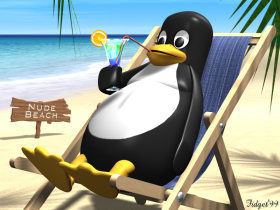
(Yeah, I know I should be saying "GNU/Linux" blah blah blah. Please feel free to shove your head in /dev/null and rant.)
Why Linux? I think every Linux user gets asked that question sooner or later, and just about every Linux blog has a post titled something like "10 Reasons to Use Linux," or "Five Reasons Why Linux is Better Then Windows." It would be quite difficult for me to compress all my reasons for loving Linux into a tidy little list, because the reasons tend to be quite numerous and I doubt that once I was done anyone would want to read it (Also, I don't like writing stupid cliched posts.). So instead, I'll give one reason why I use Linux. Its not my strongest argument for Linux (or my weakest for that matter) and I don't think its of the upmost importance, but its still a pretty good reason.
I use Linux because its easy to use.
And now every Windows user reading this is laughing and screaming insults at me. "Linux isn't easy to use, you f*ing moron! I tried to use Ubuntu and I couldn't even get it to boot. Linux is so weird and hard to use, you need to read twenty pages of documentation before you can even partition the hard drive. I spent three weeks messing with Linux and I couldn't get my sound card to work." Blah blah blah. The reasons and examples why Linux is so hard to use are almost endless.
But yes, I do think Linux is easy to use. Just about everyone that says Linux is hard to use will inevitably claim that Mac OSX or some version of Windows, which is what they're probably used to, is infinitely easier to use. People that migrate to a new environment are often startled by the strangeness of the unfamiliar, and even thought the new world may potentially offer improvements over the old, most people would still rather huddle in the warm and comfortable skirts of that which reared them. Windows users find Windows easy to use because its familiar, its what they've used for as long as they can remember and they've grown intensely fond of the inappropriately named "start" menu ( 'course Microsoft finally went ahead and gave it a new name in Vista). Lets face the facts people, Windows is only easier to use because its what you're used to, if you had grown up with Arch Linux and Enlightenment you'd probably find Windows Vista (and Mac OSX for that matter too) to be a terribly confusing operating system.
I didn't start using Linux because I thought it would be easy; I was actually expecting it to be quite difficult and it was. Initially, I had to teach myself to think and operate in a slightly different way, and to get used to typing strange commands into a terminal, but I quickly got the hang of it and within a week Fedora Core had become my default OS. I loved how easy it was to install and remove software, how i could perform powerful acts quickly with a terminal, and the vast number of software choices offered to me. But what really made Linux easy, was the fact that any problem in Linux could be fixed. I used to work as an intern in the IT department of a large company, and it always surprised me that the inevitable solution to a deadly Windows problem, was to simply reinstall the OS. Windows "experts," no matter how good they were, simply didn't know of any way to fix a reoccurring blue screen or similar problem. With closed source software, problems generally can only be resolved by the vendor, and if the vendor company is feeling cheap or lazy, the user is pretty much screwed. In Linux, a solution to a problem almost always already exists, and if doesn't, it can quickly be found.
So go Linux. The easy OS.
Categories
- Computers (27)
- Daily Log (18)
- Gadgets (5)
- Linux (34)
- Literature (20)
- Out Doors (23)
- Polyphasic Sleep (6)
- Programming (31)
- Random Stuff (47)
- School (43)
- Site News (26)
- Software (16)
- Stocks (6)
- Uncategorized (3)
- work (4)
Archives
- February 2016 (1)
- August 2014 (3)
- October 2013 (1)
- June 2013 (1)
- May 2013 (4)
- May 2012 (1)
- March 2012 (3)
- August 2011 (1)
- June 2011 (1)
- January 2011 (2)
- December 2010 (2)
- October 2010 (1)
- September 2010 (2)
- May 2010 (2)
- April 2010 (3)
- January 2010 (4)
- December 2009 (1)
- November 2009 (4)
- October 2009 (2)
- September 2009 (5)
- August 2009 (6)
- June 2009 (1)
- May 2009 (5)
- April 2009 (4)
- March 2009 (9)
- February 2009 (7)
- January 2009 (6)
- December 2008 (6)
- November 2008 (3)
- October 2008 (7)
- September 2008 (6)
- August 2008 (11)
- July 2008 (25)
- June 2008 (12)
- May 2008 (7)
- April 2008 (12)
- March 2008 (5)
- February 2008 (5)
- January 2008 (7)
- December 2007 (2)
- November 2007 (6)
- October 2007 (4)
- August 2007 (3)
- July 2007 (6)
- June 2007 (2)
- May 2007 (10)
- April 2007 (7)
Comments
- on Reasons for Buying a Refurbished Thinkpad
- on Miyata Alumicross
- on Miyata Alumicross
- on Miyata Alumicross
- on Why I Hate Remote Working

